



Ukraine is opening access to its battlefield data for its allies to train drone AI software, the country’s Defence Minister Mykhailo Fedorov said, as Kyiv seeks to harness the experience it has ?garnered fending off Russia’s four-year, full-scale invasion. Artificial Intelligence is getting into defense in a big way.
While some experts argue that AI will remain a tool to augment human decision-making, others warn that its speed and scale could push conflicts toward dangerous levels of automation.
The Anthropic Pentagon mess indicates that the ethical facets of a collaboration between AI and defense are far from sorted. But we will go ahead anyway.
What if AI had its finger on a nuke button?
As the world draws into conflicts in various corners, this is a question that must be asked and pondered with concern. If we don’t pause to understand the philosophy of AI, we might discover the trouble we’re in when it’s too late.
Read more: India’s AI Moment: Youth, Bharat & the Quiet Rewiring of the Talent Economy
In what Helen Warrell, an investigative reporter at the Financial Times, calls an “Oppenheimer moment”, on MIT Tech Review, Helen Warrell predicts a scenario where China could use autonomous AI-enabled drones, AI-driven cyberattacks, and large-scale AI-powered disinformation campaigns in a potential 2027 conflict over Taiwan.
The problem with AI is speed. It can work so fast that there might not be room for deliberation. While military leaders see AI as a way to enhance speed and accuracy in warfare, experts warn that increasing reliance on AI risks uncontrolled escalation and reduced ethical oversight. Western governments broadly agree that nuclear-launch decisions should not be delegated to AI, and the UN secretary-general has called for banning fully autonomous lethal weapons. Some researchers argue that the real combat capabilities of AI may be overstated.
However, not all see AI as the doomsday button. Professor Anthony King, the author of ‘Urban Warfare in The Twenty-First Century’, argues that AI will enhance military decision-making rather than replace humans, and that fully automated war is unrealistic. After all, current military uses of AI involve planning and logistics, cyber operations, and weapons targeting, none of which are fully autonomous.
A recent example is Ukraine’s use of AI-driven drone software, and Israel’s employment of an AI-assisted system called Lavender, which identified tens of thousands of potential targets in Gaza. Concerns exist that such systems may reproduce data biases, though some military personnel consider them more reliable than humans. Some experts claim existing laws are sufficient for AI weapons, asserting that human commanders remain responsible for their use.
The relationship between AI companies and the military has also begun to shift. In 2024, OpenAI revised its usage policies, removing an explicit prohibition on military applications. Later that year, the company partnered with defense contractor Anduril on technology designed to disable drones in combat scenarios.
Second, financial pressure is mounting. Companies like OpenAI need to offset the massive costs of training large models, and defense budgets, from the Pentagon to European governments, offer deep pockets. The US Department of Defense awarded OpenAI a US$200 million deal for cyber defense. Venture capital has followed suit, with defense-tech investment already doubling last year’s total.
China has been using swarms of robot dogs and AI drone, and the concern that the country could use DeepSeek for an era of war has been in the air. In February, China’s state-owned defense giant Norinco unveiled a military vehicle capable of autonomously conducting combat-support operations at 50 kilometers per hour. It was powered by DeepSeek.
The release of the Norinco P60 was promoted by Chinese officials as an early example of how China is using DeepSeek and AI to close the military technology gap with the United States, as both countries push their armed forces to prepare for potential conflict.
Read more: Anthropic Mythos Sparks Global Cybersecurity Fears with Autonomous ‘Superhacker’ Capabilities
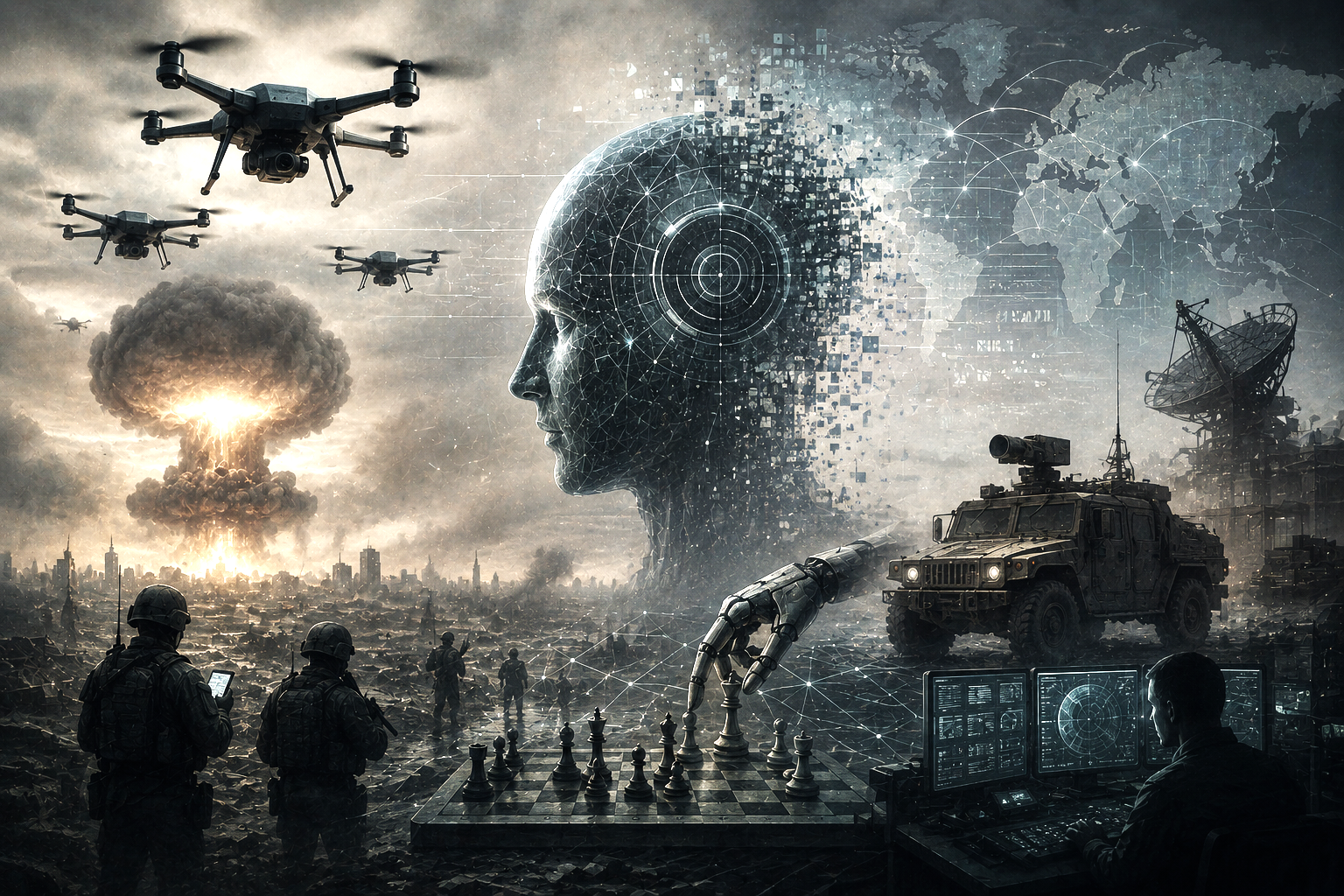
From drone swarms and AI-assisted targeting systems to autonomous military vehicles, AI is rapidly moving from research labs to the battlefield. While some experts argue that AI will remain a tool to augment human decision-making, others warn that its speed and scale could push conflicts toward dangerous levels of automation.
As governments, tech companies and militaries deepen their partnerships, the central question is no longer whether AI will shape the future of warfare, it is whether humanity can establish the ethical and strategic guardrails needed before the technology moves faster than the rules designed to contain it.